Andrew O'Hagan, Caledonian Road
“Caledonian Road"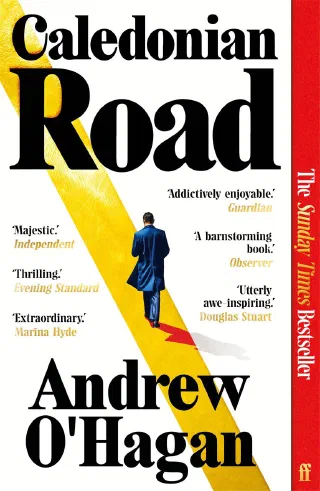 Faber & Faber paperback cover.
Miasma of Glitz ↑
I was prompted to start writing this review of Caledonian Road after reading Andrew O’Hagan’s review of “London Falling” by Patrick Radden Keefe. “London Falling” is a non-fiction book about a family’s quest to find out why their son Zac Brettler fell from the balcony of a luxury tower block called Riverwalk on the north bank of the Thames. There was all manner of false identities and funny money involved, some of it not firmly established to this day. There was, in keeping with the time of the events in pre-Covid London, a strong pointer to Russian oligarchs as London was very much their money laundromat at the time. (Also explored in a number of entertaining YouTube videos by Oliver Bullough, as well as several books of his that are on my ever-swelling to-read list.)
As I finished writing this post this week, “London Falling” was announced as the winner of the Waterstones Book of the Year and judging by O’Hagan’s review, rightly so. His review was very much in keeping with “Caledonian Road”; I got the sense of O’Hagan being familiar with real events that perhaps he too had considered or researched them as part of writing his novel. It’s certainly true that the events of “London Falling” sound like they have stepped off the pages of a novel, one that could very much be “Caledonian Road”. The review was like a “Twilight Zone” episode for me, like reading an author writing about his novel coming to life. Or to quote O’Hagan’s review: it is “a story that remains both legible and oddly unfathomable”.
That leads not just into a debate about what separates fact from fiction, but also what differentiates factual writing about fictional events from literary writing about factual events. In what sense does a fictional story “feel real” and in what sense can you transform the routine description of real world events with the tropes of genre fiction?
Dramatis personae ↑
At the front of the book there is a two page list of dramatis personae complete with a little description of each. Not only is it a handy cheat sheet for keeping track of all the characters throughout the novel, but those little descriptions whet your appetite before you start. If you aren’t gripped by the idea of a novel featuring Russian oligarchs, Chinese people-smugglers, Polish carwash owners, various posh people, art critics, art dealers, grime MCs and (very much) so on, it’s unlikely that you’ll still be gripping the book or the idea of reading it when you leave the bookshop or the library. And Caledonian Road has the added benefit of being a very tangible book, nice and thick, divided up into neat sections and that character index to leaf back to.
My paperback copy with its double flap cover needily stuffed to the gills with glowing quotes from literary luminaries and high-falutin publications, its thickness and its use of red and gold text also puts me in mind of the Jilly Cooper novels like “Polo” and “Rivals”. I’ve never read those novels officially
Why Men Weep In Their Cars ↑
The action of the novel begins with Campbell meeting his literary agent in a bar in post-pandemic London to discuss a self help book (“Why Men Weep in Their Cars”) that he wishes to publish anonymously. He’s still riding a high profile after his book on the artist Vermeer
After the meeting, Campbell is introduced to a young actor named Jake via Yuri, whose father is a Russian oligarch that happens to be backing his best friend’s business. So you can see how the character list gets to be so long. The first chapters tick along nicely with all these introductions, slotting everything together. It’s quite dense writing because Campbell does have a slightly pretentious and self-involved inner monologue that O’Hagan orbits around. I found that reading it aloud helped me to get into the story as it makes it easier to notice when I am tripping over sentences. It’s a useful approach at the start of any novel as it lets you understand what you need to get your head around, while setting yourself up for what might wash over you. At first it seemed necessary to understand all of Campbell’s angst about the modern world but as I got to know him, I did start to tune some of it out.
The novel is divided into four books. Book one, Spring, is told almost exclusively from the viewpoint of Campbell, with it changing only when dramatic irony is needed. Eventually, we radiate out from Campbell through people he interacts with and out towards the wider world. As I’ve already said, this is a chunky book with a big cast list and once it gets going, it roves far and wide.
There are several comic incidents. I quite enjoyed Campbell’s meltdown in front of his son at his own birthday party in Iceland. All the fashion and modelling stuff is superbly funny, the satire all the more pointed because it’s so close to what you see in magazines in reality. Ditto the art world stuff, where an artist is destroying works of art and exhibiting the remains. It’s so pretentious that only Damien Hirst in reality could top it.
But there’s some dark stuff too. You might not look at fish fingers the same way again. O’Hagan isn’t afraid to push the stories all the way through to their conclusions. Bad guys get their comeuppances in spades, but some sympathetic characters also experience some shocking outcomes. I’m outlining all these with my hands waving so as not to provide too many spoilers. There are definitely some “oh shit” moments, although generally O’Hagan is pretty compassionate to the characters he likes.
A Happy Ending? ↑
So what is the take-home message of the novel? Don’t use the dark web unless you are a cool hacker? Everything is a mess? No matter how much money you make, you won’t be happy until you decide you don’t need any more? Campbell starts the novel with most of the things he wants: reputation, family, satisfying job. He just has the itch that he needs more. And by the end, it is not a spoiler to say his reputation is wrecked, but he doesn’t really suffer much more damage than that. Of course, the point of the novel is the journey that we take alongside him.
Meanwhile, Milo, who is a bit of a Mary Sue character throughout, gets a happy ending of sorts - but does he deserve it? Well again, it’s tinged with a certain amount of cost. Having manipulated Campbell, he at least does the right thing by him at the end. But I was a bit disappointed that his ideal ending was just to disappear off to a Scottish island. In some ways, he makes the move that Campbell is unable to make. Campbell is constantly setting himself apart from his Scottish roots. Milo, who comes up in the globally diverse milieu of London and its internet shadow, makes the journey in reverse.
I’d recommend “Caledonian Road” wholeheartedly. Other people I’ve spoken to found it to be a bit over the top and didn’t enjoy spending time with Campbell as much as I did. Perhaps the feelings of being an outsider in London were brought back to me as I read it. I do remember the feeling of having “made it” when I moved there and also the pressure to continue on that path. I’ve enjoyed O’Hagan’s non-fiction writing in the London Review of Books and am on the lookout for more of his novels. Of particular interest is “Mayflies”, which has already been adapted into a drama by the BBC. Maybe that will be next.