Magic
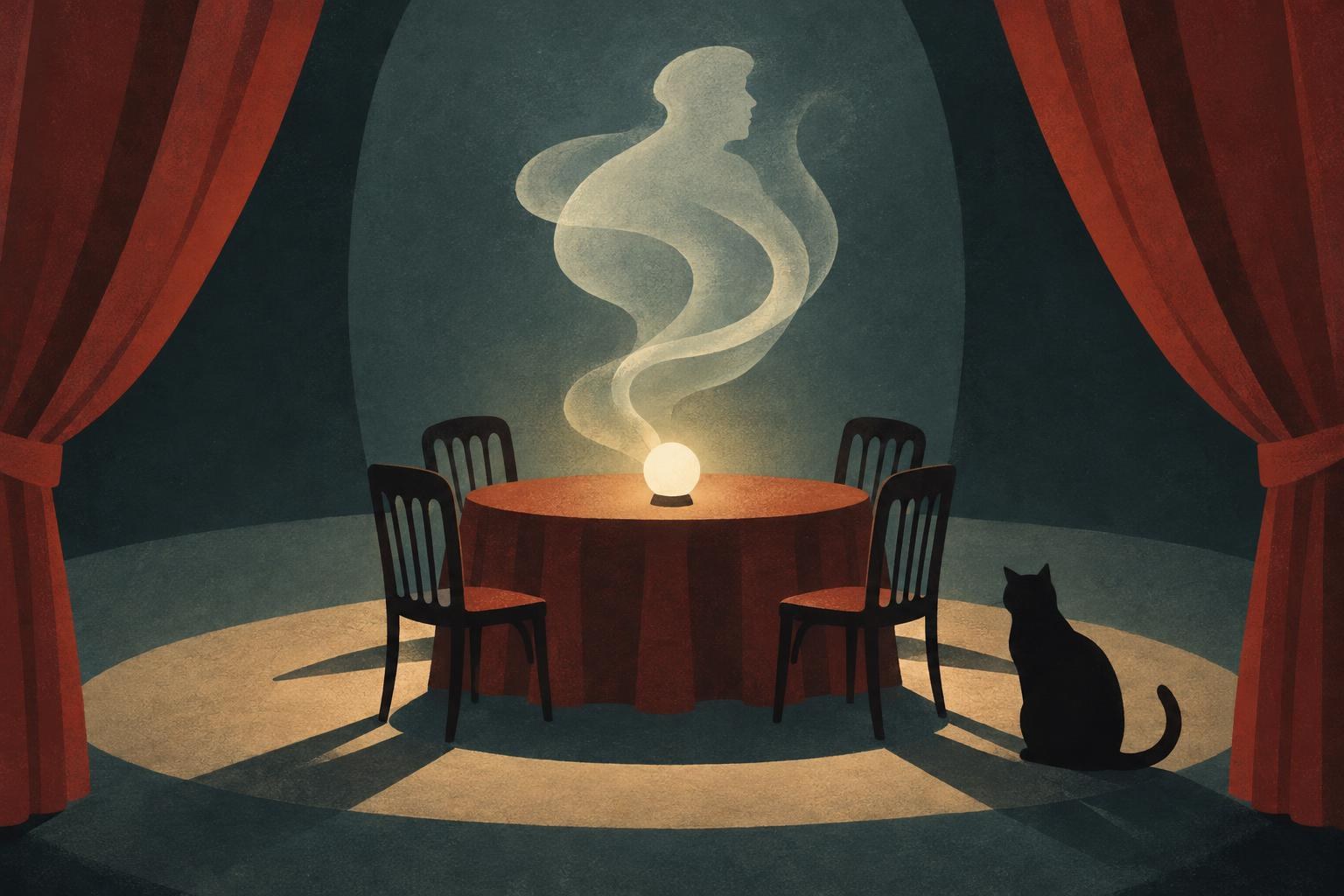
“You almost had me” - this is the line that everyone utters at some point in their experiences of seeing magic tricks performed live. At the Festival Theatre in Chichester back in May, this “Magic” moment happens to me during a seance. It was the one moment in the play where I thought “uh-oh something is going on here….”
“Magic” extends the real-life friendship between Arthur Conan Doyle, Portsmouth FC’s most famous ever goalkeeper (sort of) Conan Doyle played for an amateur club in Portsmouth that was the precursor of the later professional club. Or, if you prefer, David James was actually Portsmouth FC’s most famous goalkeeper. and creator of the Sherlock Holmes stories, and Harry Houdini the famed stage illusionist. It’s a frustrating play because it cannot decide whether it wants to be a barnstorming confection that wows its audience with magic or if it wants to debunk it all. It tries to do both in service of a narrative that sets up its two main characters as antagonists, but does neither fully because it is unable to satisfactorily resolve that conflict.
The problem is that there’s a lot that’s invented here. Conan Doyle is presented as a big believer in spiritualism due to his son’s death in the first world war, but he was already a believer by this point. Conan Doyle had a lot of interactions with both endorsing and debunking various outrageous claims of psychic ability. The play is fiction, it extends Conan Doyle and Houdini’s real life friendship to cover events beyond its time frame. It’s presented with the ring of a true story, because the characters are known to us. Inventing dialogue and additional meetings between characters whose lives we can research means that everything else about them has to be ’true’ or things start to feel off.
The success of the play is that it shows off the contrast in world-views of the two men: Conan Doyle, a slightly aristocratic wide-eyed believer ironically defined by his hyper-logical and hyper-rational creation, while Houdini is a magician epitomised by tough-talking rationality, creating magic out of hard graft. I knew next to nothing about Houdini going into the play, other than that Kate Bush impersonates his wife on the cover of her album “The Dreaming”.
The show is realistic about the (im)possibility of reconciling these two views: rationality from the producer of magic, and belief in magic from the creator of Sherlock Holmes. The problem is that this often devolves into the characters shouting at one another. The play zips along much better during razamatazz scenes featuring actual up-close magic tricks. There are also some cheeky interstitial scene changes that peek behind the curtain. But just like the world-views, the magic and the drama are often kept separate, save for the first seance scene, which is a crackling tour de force that would be a perfect fit for a horror movie. Later on, Houdini uses a second seance in the play to debunk the medium, and for the audience mediums (media?) in general. This quickly devolves into shouting and name-calling, tense in an altogether different way.
A later scene explains the ‘materialisation’ or ‘walking through the wall’ trick for Conan Doyle’s benefit. The Holmesian axiom is that one should eliminate the impossible and accept the improbable. That this is the key to understanding the artifice of both tricks is lost on David Haig’s brilliantly clueless Conan Doyle. He’s portrayed as maintaining his belief even when the trick is explained, just as victims of cults and scams often are. Hadley Fraser as Houdini - restless, pugilistic and self-assured throughout - has to simply shake his head and walk away.
But what to make of it as an audience? Living as we do in fractured times, there is a great desire for ways to reconcile divergent world views. The technology we now have compared to when this play is set delivers us knowledge and magic in equal measure, and those who have picked the sides are drifting further and further apart. For a second I thought this play might deliver some revelation, some method to bridge the gap between magic and realism. But the play is keener on revealing some tricks rather than others. Like I said, it almost had me.